
By early January 1945, the War Department and WAC leadership were engaged in the final stages of preparing selected personnel for overseas service. Across the United States, Wacs stationed at various posts were being transferred to the Third WAC Training Center at Fort Oglethorpe, Georgia, where they would undergo two weeks of overseas training. For many, this marked the culmination of extensive preparation and the beginning of an assignment unlike any they had experienced before.
Honor Parade at Fort Des Moines
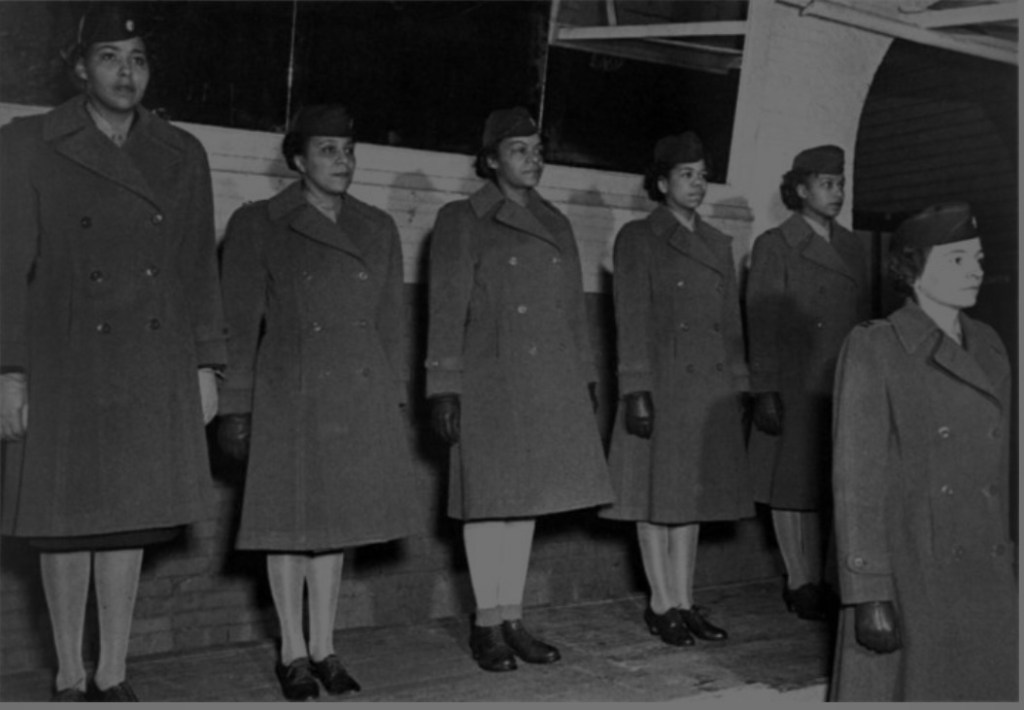
Eighty years ago today, January 9, 1945, at Fort Des Moines, an honor parade was held to mark the departure of key members of the 6888th Central Postal Battalion. Major Charity Adams, who would soon become the battalion’s commanding officer, reviewed the parade alongside future 6888 officers Captain Mildred Carter and 2nd Lieutenant Gussye Stewart.
The Departure from Fort Huachuca
At Fort Huachuca, Arizona, ten Wacs selected for overseas service were photographed before their departure. This image provides a glimpse of one of many groups chosen from installations nationwide for this critical assignment. These women—Private First Class Dorothy Reid, Technician Fifth Grade Lucia M. Pitts, Private First Class Marie B. Gillisslee, Private Charlotte Cartwright, Technician Fifth Grade Edna Burton, Technician Fourth Grade Evelyn C. Martin, Technician Fourth Grade Mildred Peterson, Technician Fifth Grade Alice Allison, Technician Fifth Grade Fannie Talbert, and Private First Class Mildred Gates—completed Extended Field Service Training (EFST) and went on to serve in the 6888th.
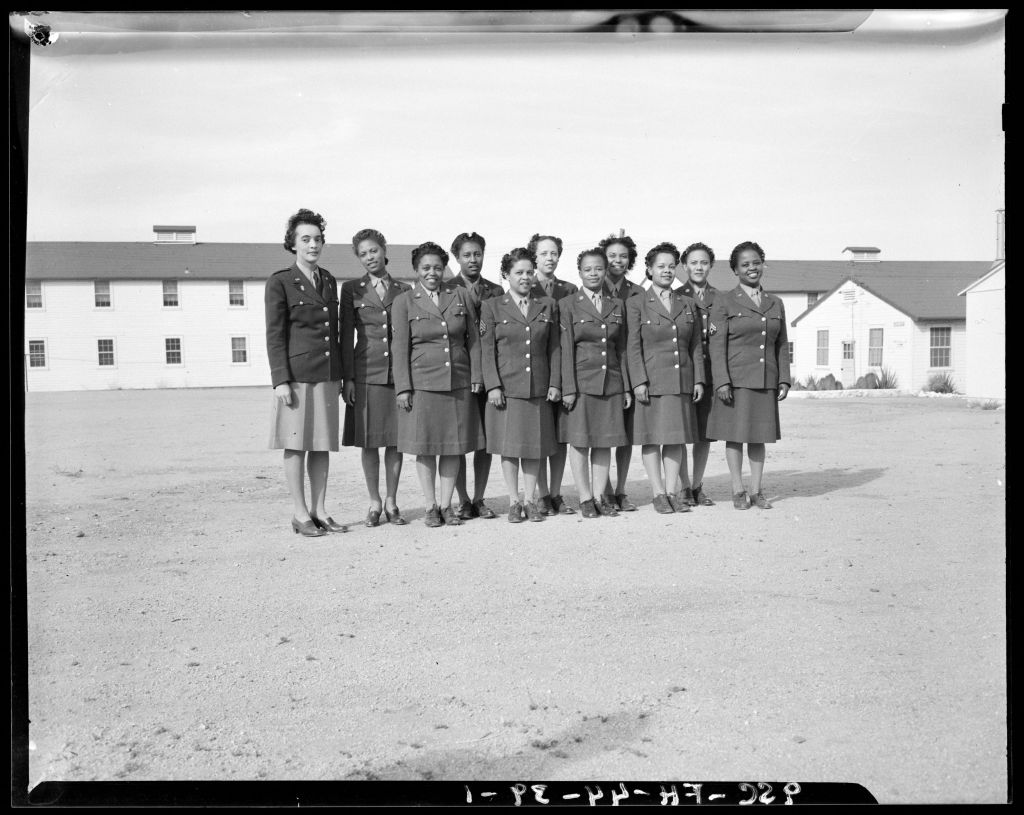
Miller, Jack, and Jack Miller. “Recent recruits for foreign service.” Photograph. [December 27, 1944]. Digital Commonwealth, https://ark.digitalcommonwealth.org/ark:/50959/02873b820 (accessed January 06, 2025).
The St. Louis Argus chronicled the departure of these Wacs, describing them as “on their way to render more vital service to their country in foreign lands.” This statement reflects the significance of their assignment as they prepared to join a unit tasked with meeting the logistical and morale needs of soldiers abroad, all while navigating the realities of a segregated military.
Preparing for Extended Field Service Training
Before leaving for Fort Oglethorpe, the last few days were filled with logistical challenges on an individual level. Packing was particularly tough, as enlisted women had to fit their belongings into limited bags, often sending personal items home. The shift from the relative comforts of their home stations to the strict packing constraints for overseas service signaled the transition from familiar routines to the uncertainties of deployment abroad.
Reality vs. Film Depiction in Six Triple Eight
This period of preparation is notably absent in Tyler Perry’s Six Triple Eight, which instead depicts a fictionalized and consolidated imagining of training at Fort Oglethorpe. The film does not reflect the distinct experiences of Wacs as they transitioned from various stations nationwide, including the honor parades and preparations that marked their final days in the United States.
In the next post, we’ll take a closer look at the Extended Field Service Training conducted at Fort Oglethorpe, examining its structure, purpose, and the experiences of the Wacs as they prepared for deployment overseas. We’ll also explore how the realities of this training differed significantly from its depiction in Six Triple Eight.
 Lipstick & War
Leave a comment