
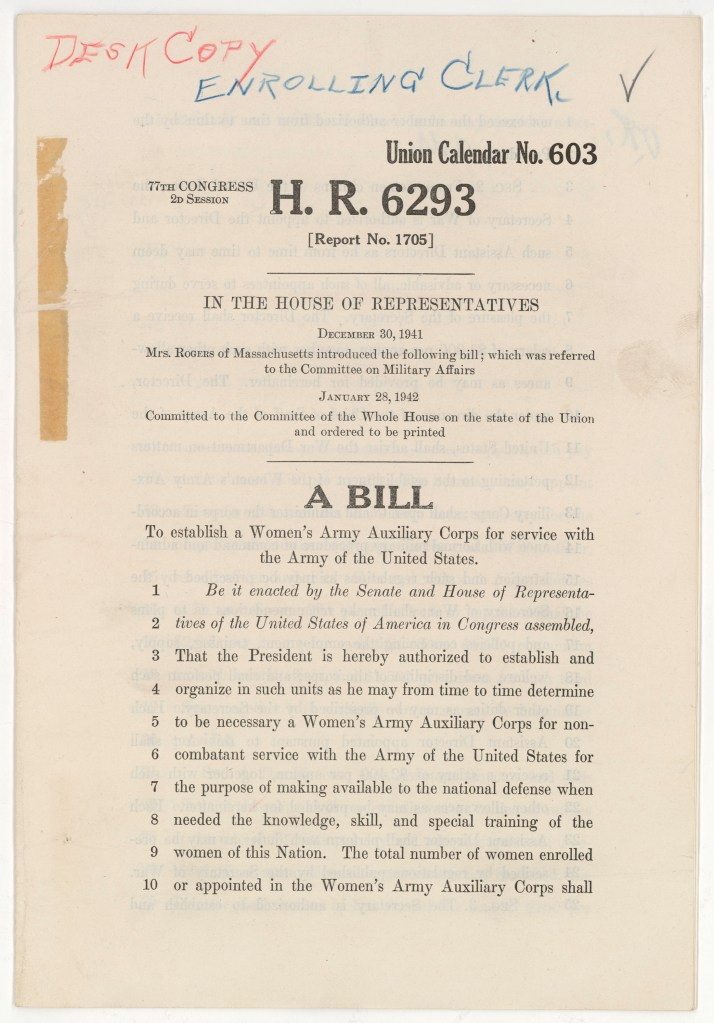
Following Edith Nourse Rogers’ introduction of HR 6293 on December 30, 1941, the bill was sent to the Committee on Military Affairs for review on January 20, 1942. On Friday, January 28, the committee chairman, Andrew J. May (D) of Kentucky requested to “have until midnight to file a report on the bill relating to Women’s Auxiliary Corps for the Army.”[1]
Report 1705 made no amendments to HR 6293 and was submitted to the House Clerk for printing. The next step for the WAAC bill was referral to the Committee of the Whole House on the State of the Union.
The Associated Press reported on the following Monday that American women were “ready to trade the glamour of peacetime for the grime and grand of behind-the-lines Army jobs.” The article quoted Representative May who (ignoring the struggles of HR 4906) stated “there has been no opposition” to the proposed bill. Also quoted was one of the seven female members of the House of Representatives, Frances Bolton (R) of Ohio: “We don’t want glamour, we want work. We don’t want your jobs, but the women should walk side by side, shoulder to shoulder with men. We want to make this a fighting world for you, an assisting world for us.”[2]
While January 1942 was a successful month with rapid progress for the bill, the next months would be filled with planning and minutiae while it made its way towards becoming law.
[1] Representative May, speaking on HR 6293, on January 28, 1942, 77th Cong., 2nd sess., Congressional Record 88, pt. 1:797.
[2] Alex Singleton, “Petticoat Army Wins Backing,” The Idaho Statesman, January 31, 1942, https://www.newspapers.com/image/723189953/
 Lipstick & War
Leave a comment